
Water treatment & RO plants
Water treatment. Designed from your water report.
We manufacture RO and water-treatment plants from 50 to 20,000 litres per hour. Every treatment stage is designed around your feed-water quality and how the treated water will be used.
Capacity & construction
One plant range, sized for the intended use.
RO and water-treatment plants for drinking water, beverage processing and utility duties.
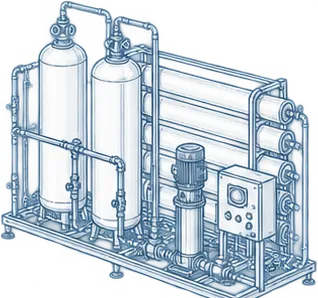
- Capacity range
- 50–20,000litres per hour
- Construction
- FRP or SS304SS316/316L where required
- Applications
- Packaged drinking water
- Juice, CSD and dairy processing
- Hotels and institutions
- Rinsing, CIP and industrial utility make-up
Indicative range, subject to feed-water quality and the required treated-water specification. Final polishing and water-quality requirements are defined for each use.
Our workshop at Sikandrabad, Uttar Pradesh, is being developed for this manufacturing programme.
Treatment train
Two stages, selected from your water analysis.
Feed storage, filtration, softening or dosing where required, RO, mineral adjustment and final disinfection are all chosen from the analysis.
- 01
Feed assessment & pretreatment
- Raw-water tank
- Feed pump
- Sand/carbon filtration
- Cartridge filter
Added as the water analysis requires
- Dechlorination
- Softening
- Iron removal
- UF
- Dosing
- 02
RO separation & final conditioning
- High-pressure pump
- RO membranes
- Permeate
- Specified disinfection/mineral adjustment
- Treated-water tank
Reject remains separate, for suitable reuse or disposal.
RO engineering & fabrication
Engineered around your water.
From water analysis and hydraulic design to material selection, welding quality and practical day-to-day maintenance.
Raw-water & product-quality basis
We review the raw-water analysis alongside your treated-water targets and daily demand.
- TDS/conductivity
- pH
- Hardness
- Alkalinity
- Chlorides/sulphates
- Silica
- Iron/manganese
- Turbidity/SDI
- Chlorine
- Microbiology
Water balance & hydraulic design
We assess feed, permeate and reject flows together with operating hours, feed temperature, recovery, scaling risk and pressure losses. Recovery is selected for the water chemistry.
FRP, SS304 & SS316 construction
We offer FRP-vessel and all-SS304 configurations, with SS316/316L where greater corrosion resistance is needed. Chlorides, temperature and cleaning chemistry govern the final material selection.
Welding, joints & internal finish
Stainless fabrication considers suitable TIG procedures, compatible filler and shielding or back-purging where needed, sound weld roots and controlled heat input. Weld cleaning and pickling/passivation are specified as appropriate.
Hygiene, layout & maintainability
We consider drainability, reduced stagnant pockets, accessible joints, pipe supports, pump alignment and space for media replacement, membrane removal and servicing. Wetted seals and finishes suit the application.
The stainless grade alone does not ensure a hygienic plant.
Joint design, weld quality, surface condition, cleaning access and operation are considered together.
RO components & controls
Matched components. Dependable operation.
Membranes, pumps, pressure vessels, piping, instruments and electrical protections are selected as one system, matched to flow, pressure, recovery, source-water chemistry, cleaning and maintenance needs.
Membrane selection & arrangement
Membrane type, active area, element count and staging are matched to feed quality, temperature, required rejection and output. OEM projections and limits for flux, recovery and feed/concentrate flow guide the selection.
Pumps, motors & energy demand
Feed and high-pressure pumps are selected from duty-point curves for the required flow and head, including system losses. We check inlet conditions, cavitation margin, wetted materials, seals and motor efficiency.
Pressure vessels, piping & fittings
We check vessel pressure and temperature ratings, media loading, backwash duty and chemical compatibility. Pipes, valves, fittings and gaskets are sized for flow, pressure, cleaning needs and service access.
Instrumentation & plant protection
Pressure, flow and conductivity/TDS monitoring support operation. Tank-level, low-feed-pressure, high-pressure and motor-protection interlocks are configured with flushing, dosing and alarms to suit the project.
Switchgear & control-panel engineering
Breakers, contactors, overload protection, cables and any VFD are selected for motor current, starting duty and fault level. Earthing, isolation, enclosure protection, heat dissipation and manual/automatic controls are considered.
Before handover
- Agreed leak and pressure checks
- Flushing
- Instrument and interlock tests
- Flow and quality verification
- Operator training
Storage, disinfection & cleaning
SS tanks, UV, ozone and CIP. Hygienic plant connections.
Manufactured and fabricated for the product, the installation conditions and the agreed inspection requirements.
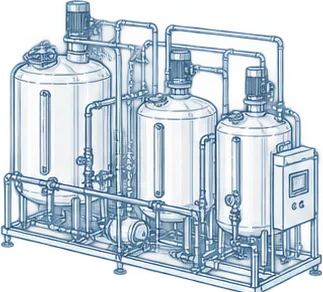
SS storage & ozone-mixing tanks
Tank capacity, material grade, connections, level measurement, vents, cleaning access and drainage are specified for the duty. Wetted components and seals are selected for the water quality and cleaning conditions.
UV systems & ozone generators
UV, ozone and contact arrangements for final disinfection are matched to the process and supplied according to the project scope.
Clean-in-place systems
Manual-assisted, semi-automatic or automatic cleaning arrangements are selected around the equipment, required flow and agreed sequence. Cleaning concentration, temperature, contact time and rinsing checks are part of the process.
Piping, welding & conveyors
Process piping, valve positions, pump access, supports, weld finish and cleaning access are considered together. Conveyor routing links the blowing, filling, labelling, coding and packing stations.
Quality basis: material grade, fabrication finish, inspection stages and acceptance requirements are documented in the approved technical scope.
Product category
Packaged drinking water or natural mineral water?
The two require different source and process assessments.
Packaged drinking water
Treatment is designed from the source-water analysis. It may include filtration, RO, mineral adjustment and disinfection before hygienic filling.
Natural mineral water
A source-specific product whose natural mineral character must be protected. Source qualification and permitted treatment are assessed separately.
An RO plant does not by itself produce natural mineral water. Installing one alone does not establish that product category.
Project enquiries
Start with your raw-water report.
Share your water analysis, intended use, daily demand and operating hours. We design the treatment train, materials and controls around them and send a clear technical proposal.